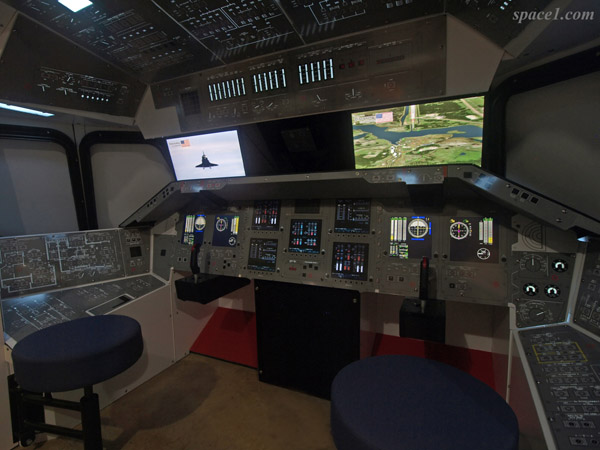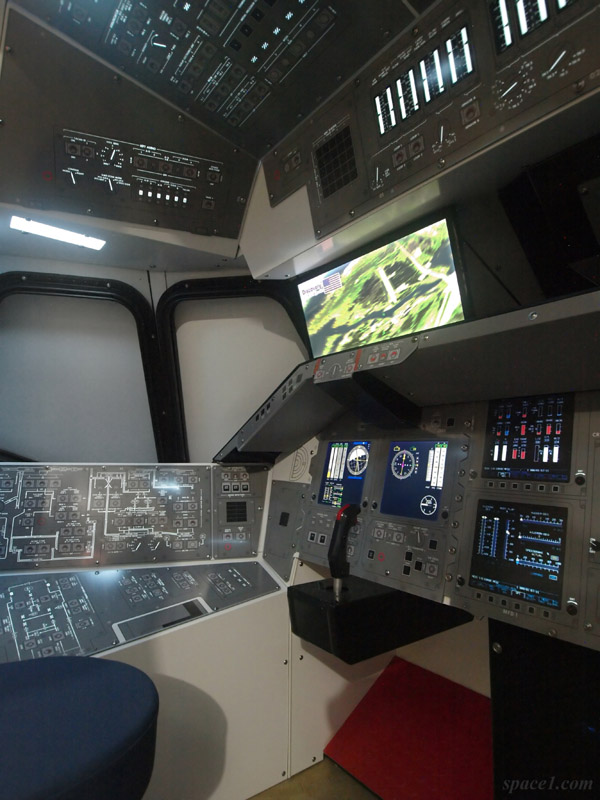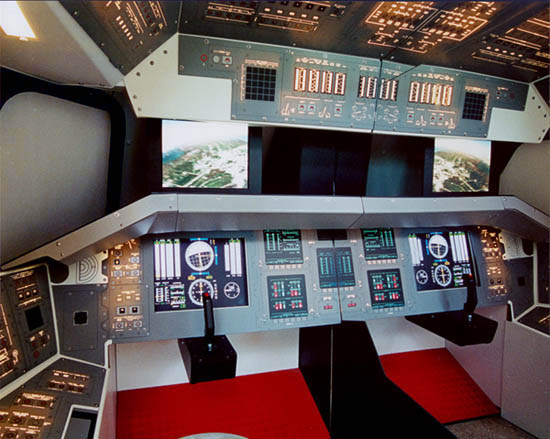
The Columbia II Space Shuttle Landing Simulator reproduces the
left half of the shuttle cockpit. A mirror gives the illusion of sitting in the full cockpit.
Interior Views
The Columbia II Space Shuttle Landing Simulatorcombines a
recreation of the Space Shuttle cockpit with exhilarating software that reproduces the successful conclusion of the Space Shuttle’s mission with its return from Earth orbit.
Special features:
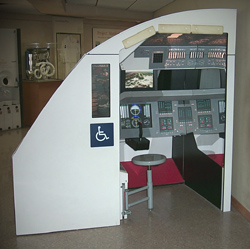
Wheel chair accessible per ADA guidelines.
Illuminated control panels with 10,000 hour rated long-life lamps.
Right wall mirrors the interior, giving the illusion of being inside the full cockpit (or
have the full forward cockpit experience).
Welded steel frame.
Assembled dimensions (at entry side): 78” wide x 75”
tall x 72” deep.
Dismantles to fit through a 36” wide doorway.
Dual monitors (window view and control panel instruments view).
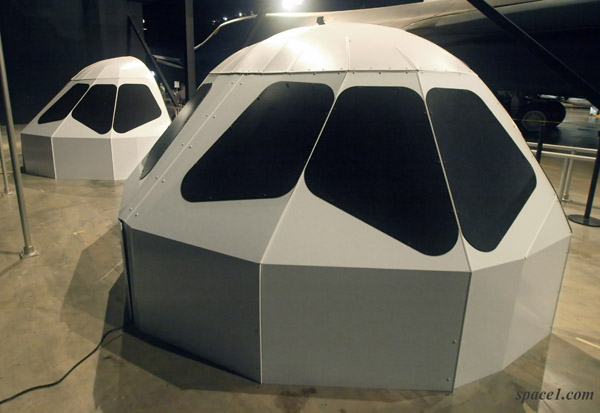
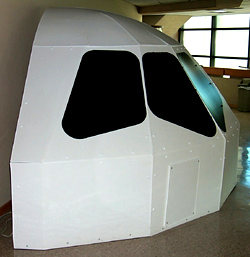
Accurately reproduced window frames.
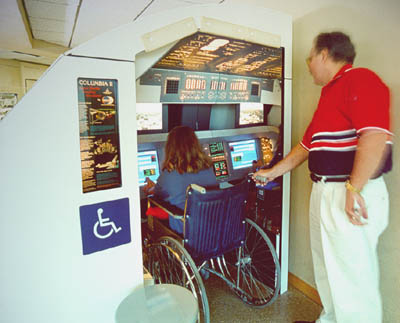
Illuminated display at entry describes how the shuttle lands.
Industrial grade stool rotates out for wheel chair access.
Sturdy arcade-style joystick.
Our approach to exhibit design yields a simple cockpit with accurate dimensions, enhancing the experience.
Exterior Views
Detailed Description
Your visitor sits in an accurate recreation of the commander’s station on the
shuttle flight deck.
Aspiring astronauts undergo a brief flight instruction session, then guide the shuttle on
its approach and landing at the 15,000 foot-long Shuttle Landing Facility runway at the Kennedy Space Center.
From training through landing the experience lasts about five minutes.
The simulator integrates the popular Space Shuttle Landing Simulator
software by Binary Star Ltd.
The experience is brimming with the sights and sounds astronauts experience.
On a cockpit window monitor, visitors see the rapidly approaching terrain as the shuttle gets closer and closer to
touchdown at the KSC.
The voice of Mission Control feeds the “pilot” information based on actual flight conditions.
After landing, the visitor receives a short feedback session from the computer describing their
mission’s outcome.
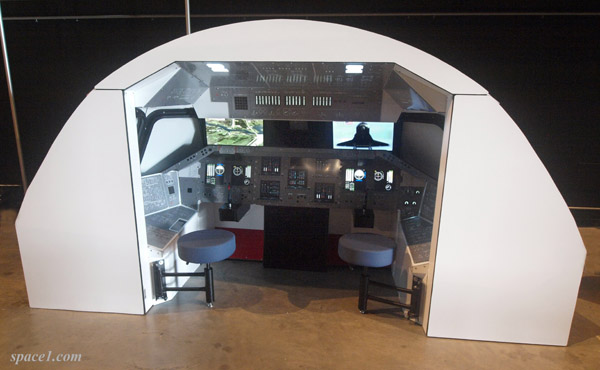
A full forward cockpit gives two visitors an independent experience. Seats swing out for wheel chair access.
Panels are backlit for added realism. (Exhibit coming soon to National Museum of the United States Air Force in Dayton, Ohio.)
Dr. Douglas Rittman of El Paso, Texas and his daughter Susie Rittman enjoy the wheel chair
accessibility of the Columbia II at the New Mexico Museum of Space History in Alamogordo, New Mexico.
The simulator enclosure may be configured as needed. Above, the full forward flight deck provides
positions for two separate simulations. Portable seats are used in place of swing-out stools, still allowing wheelchair access. The open design also encourages a group experience.